Article 5: emotion recognition at work is already banned
Edition 17. A reading time of about 4 minutes.
The hook
Most of what you have read about the EU AI Act comes with a date in the future. High-risk hiring rules, vendor paperwork, the next deadline to plan for. Article 5 is different. It is the short list of practices the Act bans outright, and one of them touches hiring directly: AI that infers the emotions of workers or candidates. This is not a duty arriving in 2026 or 2027. The prohibition has applied since 2 February 2025. If something in your recruitment stack reads tone of voice, facial expression or "engagement" to score how a candidate feels, it is already in scope.
What this means
Article 5 lists the AI practices the EU treats as unacceptable, full stop. The one for employers is in point (f). The text bans "the placing on the market, the putting into service for this specific purpose, or the use of AI systems to infer emotions of a natural person in the areas of workplace and education institutions, except where the use of the AI system is intended to be put in place or into the market for medical or safety reasons" (AI Act, Article 5(1)(f)). In plain terms: you cannot use AI to read how an employee or a candidate is feeling, with a narrow exception for medical or safety purposes.
Three parts of that sentence decide whether it reaches you.
The first is what counts as an emotion recognition system. The Act defines it as "an AI system for the purpose of identifying or inferring emotions or intentions of natural persons on the basis of their biometric data" (AI Act, Article 3(39)). Biometric data is the operative phrase. A tool that infers a candidate's mood from their face on video, from the pitch and pace of their voice, or from similar bodily signals, is the target. This is squarely in the territory of some AI video-interview and "candidate engagement" products.
The second is the exception, which is narrower than it sounds. The carve-out is for systems put in place "strictly for medical or safety reasons", and Recital 44 gives the example of "systems intended for therapeutical use" (AI Act, Recital 44). A fatigue monitor that exists to keep a machine operator safe can fall inside it. An interview tool that scores enthusiasm or confidence to rank applicants does not. "It helps us hire better" is not a safety reason.
The third is why the EU drew this line, which tells you how regulators will read close cases. Recital 44 points to the "limited reliability, the lack of specificity and the limited generalisability" of inferring emotion from biometric signals, and to the "imbalance of power in the context of work or education, combined with the intrusive nature of these systems". The concern is both that the science is weak and that the setting, an employer over a candidate, leaves the individual little room to object. That framing makes it unlikely a borderline hiring use will be read generously.
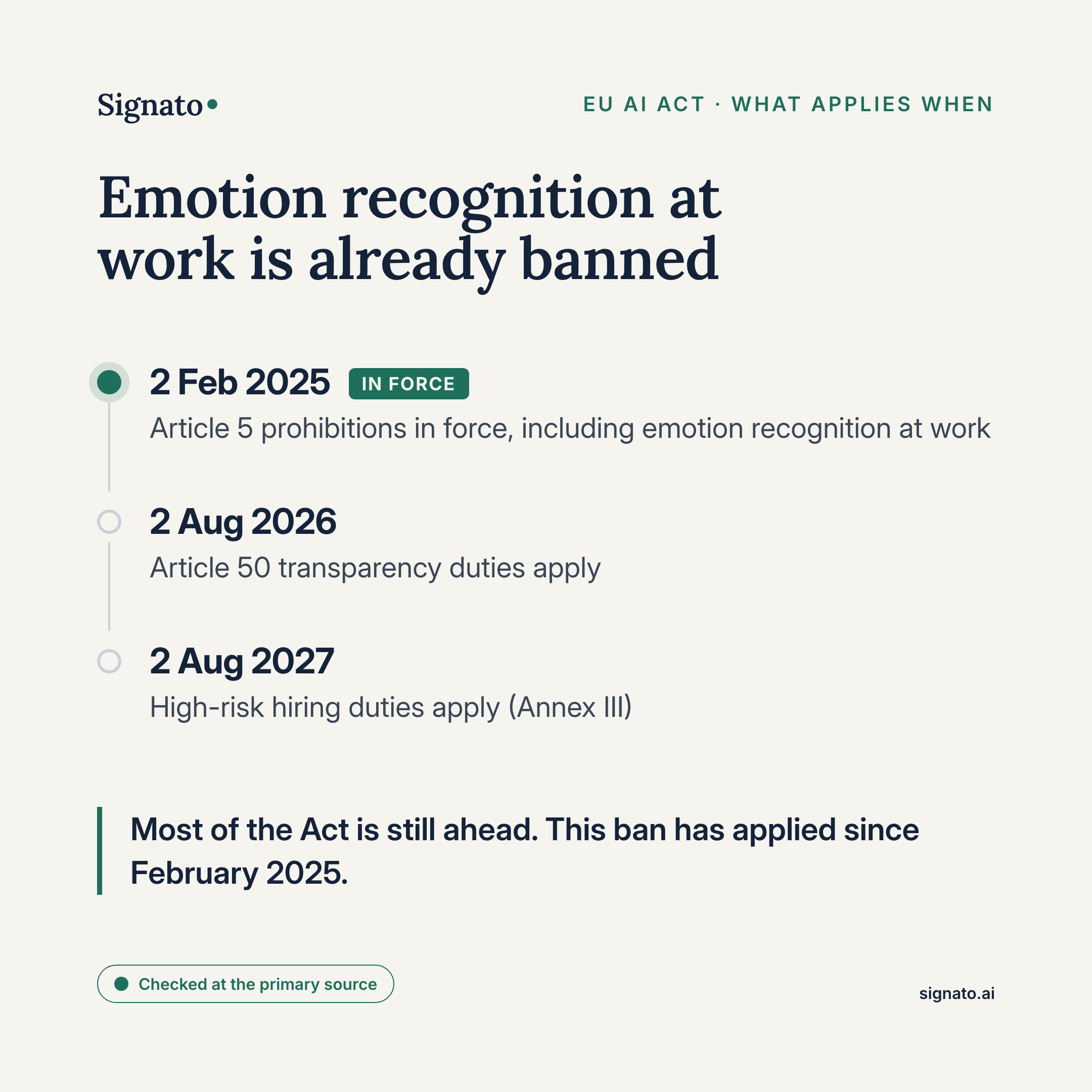
Now the timing, which is what makes this worth your attention today. The prohibitions in Article 5 sit in Chapter II, and Article 113 states that "Chapters I and II shall apply from 2 February 2025" (AI Act, Article 113(a)). So this is not a future obligation to schedule. It has been in force for over a year. And it is on firm ground: the Commission's Digital Omnibus package, which would move some high-risk deadlines later, remains provisional and is not yet in the Official Journal, and the Article 5 prohibitions are not part of that proposed delay. While the high-risk calendar is still being argued over, this ban is settled and live.
What to do with this
You do not need a lawyer for the first pass. This is mostly about knowing what your tools actually measure.
- Find anything that scores emotion, sentiment or engagement. Look hardest at AI video interviewers, voice screeners and "candidate experience" analytics. The question is not the marketing label, it is whether the tool infers a person's emotional state from face, voice or other biometric signals. If it does, in a hiring context, it is in scope.
- Ask the vendor a direct question, in writing. Does the system infer emotions or intentions from biometric data, and on what legal basis does it continue to operate in the EU after 2 February 2025. A confident vendor will answer plainly. Vague answers are themselves a finding.
- Do not treat "for better hiring" as a safety reason. The exception is for medical or safety use, read strictly. If a feature exists to rank or filter candidates by how they seem to feel, switch it off for EU candidates rather than argue the carve-out.
- Write down what you checked. A short record of the tools reviewed, what each measures, and what you turned off is the evidence that you acted. This is a prohibition, not a paperwork duty, so the goal is to not be doing the banned thing, and to be able to show it.
Read this way, Article 5 is one of the easier parts of the Act to act on, because the answer is binary. Most hiring AI is not affected. The narrow slice that reads emotion from a person's body is, and that slice has been off-limits since February 2025. The teams in good shape are not buying anything new. They have checked what their tools measure and turned off the feature that crosses the line.
This is educational material and a starting point, not legal advice. The EU AI Act is still being amended, and parts of the high-risk timetable are among the provisions proposed for change under the Commission's Digital Omnibus package, which is not yet final law. The Article 5 prohibitions discussed here are not part of that proposed delay and have applied since 2 February 2025 under the Act as published, but how the rule applies depends on the specific facts, on the design of the particular tool, and on national enforcement. For your situation, consult a qualified lawyer. Signato is not a law firm and does not certify compliance.
Not sure whether anything in your hiring stack reads emotion? Take the free AI Hiring Risk Self-Assessment to see where you are exposed, then see the same evidence-first discipline applied to what your AI sends out: the free local trial of the Signato chamber blocks a draft that pairs the wrong person with the wrong subject before it leaves, no card, nothing leaves your machine.
Every claim here is traced to the primary regulation and checked by a person before it goes out. We tell you what is settled, what is still open, and what to do next. Know someone who uses AI in hiring in the EU? Forward this to them.
Sources (primary, read 2026-06-22):
- AI Act, Article 5 (Prohibited AI practices), Article 5(1)(f) prohibits placing on the market, putting into service for this specific purpose, or using AI systems to infer emotions of a natural person in the areas of workplace and education institutions, except where the system is intended for medical or safety reasons. - AI Act, Article 3 (Definitions), point (39) defines an "emotion recognition system" as an AI system for the purpose of identifying or inferring emotions or intentions of natural persons on the basis of their biometric data. - AI Act, Article 113 (Entry into force and application), subparagraph (a) states that Chapters I and II shall apply from 2 February 2025; Article 5 sits in Chapter II, so the prohibition is already in force. - AI Act, Recital 44, explains the prohibition by reference to the limited reliability, lack of specificity and limited generalisability of these systems and the power imbalance in work and education, and notes the exception for systems placed on the market strictly for medical or safety reasons, such as therapeutical use. - Canonical text: Regulation (EU) 2024/1689, EUR-Lex CELEX:32024R1689.
Every claim here is traced to the primary regulation and checked by a person before it goes out. We tell you what is settled, what is still open, and what to do next. How we work.
Know someone who hires in the EU? Forward this to them.